

Are 90s Comic Books Worth Anything? (The Honest Answer)
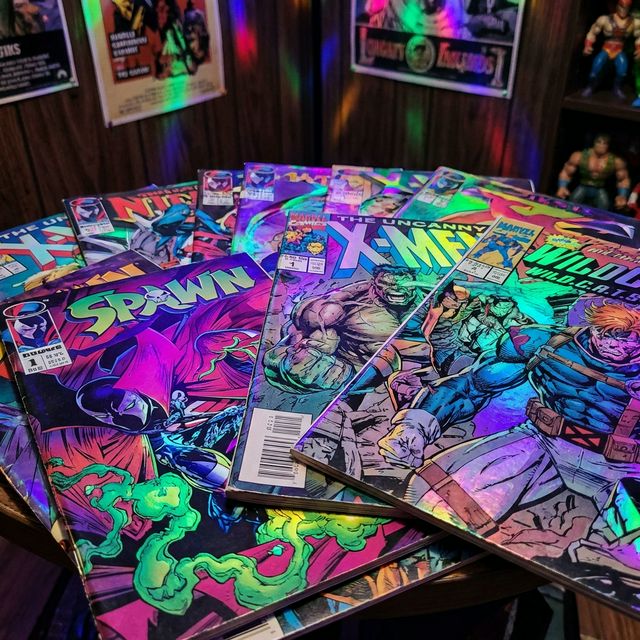
If you grew up in the 90s, you probably remember the hype. Comic shops were popping up on every corner, and every single issue was advertised as a “future collector’s item.” We saw holographic covers, die-cut covers, polybagged “Death of Superman” issues, and more variants than you could shake a stick at.
The result? Millions of people bought these books, threw them in a closet, and expected to retire on them twenty years later.
Now, those twenty years have passed. You’ve gone into the attic, pulled out that longbox, and you’re wondering: “Is there anything in here, or is this just heavy recycling?”
The answer is… it’s complicated. But don’t throw them out yet.
The Problem: The Speculator Bubble
To understand why most 90s comics are worth exactly what they cost in 1992 (about two dollars), you have to understand the Speculator Bubble.
In the early 90s, the world went crazy for comics. People weren’t just buying one copy to read; they were buying five copies to “invest.” Publishers responded by printing millions of copies. X-Men #1 (1991) sold over 8 million copies. X-Force #1 sold over 5 million.
In the world of collectibles, value = demand / supply. When the supply is 8 million, the value stays low forever.
The “Trash” (What Most People Have)
If your box is full of the following, I have some bad news for you:
- X-Men #1 (1991): unless it’s a very rare gatefold error, it’s a $5 book.
- X-Force #1 (1991): even with the card still inside, it’s about $5-$10.
- Superman #75 (Death of Superman): millions of these were printed. The black polybagged version is neat, but it’s rarely worth more than $20.
- Youngblood #1: The start of Image Comics, but printed in massive quantities. $2-$5.
The “Treasure” (The 90s Gems)
However, it’s not all doom and gloom. The 90s gave us some of the most iconic characters in comic history, and their first appearances are legitimately valuable—especially in high grade.
1. New Mutants #98 (1991) – 1st Deadpool
This is the holy grail of the 90s. Deadpool has become a global phenomenon, and his first appearance is a must-have. A copy in CGC 9.8 (Near Mint/Mint) can easily sell for $1,000 to $1,500. Even a raw, mid-grade copy can pull $300.
2. Venom: Lethal Protector #1 (1993) – Error and Gold Variants
While the standard red foil cover is common, there is a “Black Error” version and a “Gold” version that are worth significantly more. Collectors love errors and limited variants.
3. Edge of Spider-Verse #2 (Wait, that’s 2014, let’s stick to 90s)
Let’s look at Batman #457 (1990)—the first time Tim Drake put on the Robin costume. Or The Amazing Spider-Man #361 (1992)—the first full appearance of Carnage. A high-grade ASM 361 is a cornerstone of any 90s collection and can fetch $400-$600.
4. Bone #1 (1991) - Self-Published
If you have a first print of Jeff Smith’s Bone #1, you’ve hit the jackpot. Because it was self-published with a low print run, it is incredibly rare and can sell for thousands.
The Condition Factor: The “9.8 or Bust” Rule
Because so many 90s comics were saved and bagged immediately, the market for “raw” (ungraded) 90s comics is flooded. To get real money, your book almost always has to be a CGC 9.8.
Collectors in the 90s market are perfectionists. A tiny white tick on the spine can drop the value of a Spawn #1 from $150 down to $20.
How to Check Your 90s Collection
Don’t spend hours on Google. The fastest way to see if you have the “good” issues or the “junk” is to use the ComicValue scanner to identify your books by their cover instantly.
When you use the ComicValue app, we don’t just tell you the price of the book—we tell you the price of the specific variant you’re holding. Is it the newsstand edition? Is it the 2nd printing? In the 90s, these small details make all the difference.
Look for “Newsstand” Editions
In the 90s, most people bought comics at comic shops (“Direct Market”). A small percentage were sold at grocery stores and newsstands. These “Newsstand” editions are often rarer and can carry a premium of 2x to 5x over the standard direct market version. Check your barcode—if it has a longer string of numbers, it might be a newsstand!
Conclusion
Are 90s comics worth anything? Generally, no. But specifically? Yes.
If you have a box of Image, Marvel, and DC books from 1990-1995, you likely have about $100 worth of “bulk” comics and maybe one or two $50-$200 “keys.” The trick is knowing which is which without going insane in the process.
Take an afternoon, grab a drink, and start scanning. You might not be able to buy a private island, but you might just find enough value to fund your next great hobby.
Stop wondering and start knowing. Download ComicValue for iOS or Android and see what your 90s collection is really worth.
Frequently Asked Questions
Are 90s comic books worth anything?
Most are not — publishers printed millions of copies of popular 90s titles like X-Force #1 and X-Men #1, making them nearly worthless. However, specific 90s keys like New Mutants #98 (1st Deadpool, worth $300–$1,500+ raw) and Amazing Spider-Man #361 (1st Carnage) are genuinely valuable.
Why are most 90s comics worth so little?
Overproduction. In the early 90s, print runs for popular titles like X-Force #1 or X-Men #1 were in the millions, leading to a massive supply that far exceeds demand.
Which 90s comics are actually valuable?
The top 90s keys include New Mutants #98 (1st Deadpool), Amazing Spider-Man #361 (1st Carnage, full), Bone #1 (self-published, very low print run), Batman #457 (1st Tim Drake Robin), and Venom: Lethal Protector #1 (error variants). In high grade (CGC 9.8), these can sell for hundreds to thousands of dollars.
Are X-Men comics from the 90s worth anything?
The X-Men #1 (1991) gatefold cover is common (worth ~$5), but some X-Men 90s keys have value: Uncanny X-Men #266 (1st Gambit) and X-Men #4 (1st Omega Red) are legitimate keys worth $50–$300+ in high grade.
How do I check if my 90s comics are valuable?
Scan them with the ComicValue app or search eBay's 'Sold Items' filter for the specific issue. Focus on CGC 9.8 prices — in the 90s market, condition is everything.